How to Become an F1 Mechanic: The Complete Career Guide
Becoming a Formula 1 mechanic takes more than knowing how to repair a road car. F1 teams need people who can build, service and change extraordinarily complex racing cars with total accuracy, often under intense time pressure.
The usual route is to gain a practical automotive or motorsport qualification, build hands-on experience and work your way through club racing or a junior championship. A university degree is not normally essential for a mechanic, but relevant training and real race-team experience are.
Competition is fierce, and very few people move directly into a travelling F1 role. That does not make the goal unrealistic. It means you need to treat Formula 1 as the final step in a career plan, rather than the first job on your list.
This guide explains what F1 mechanics actually do, which qualifications help, how to gain experience, where to find your first opportunity and what life inside a race team is really like.
The short answer: how do you become an F1 mechanic?
Most aspiring F1 mechanics should follow these steps:
- Build a strong foundation in maths, science and practical engineering. You do not need perfect grades, but you must be comfortable measuring, diagnosing and working precisely.
- Complete a relevant qualification or apprenticeship. Good options include automotive maintenance, motorsport engineering, advanced manufacturing or a related technical discipline.
- Get hands-on experience. Work on road cars, karts, racing cars or engineering projects. Teams want evidence that you can use tools properly and solve real problems.
- Enter motorsport at an achievable level. Club racing, karting, Formula 4, Formula Ford, GT racing and other national series can all provide valuable experience.
- Build a reputation for accuracy and reliability. Motorsport is a small industry. Being trusted to do the job correctly, on time and without drama matters enormously.
- Progress into faster and more demanding championships. As your skills and contacts develop, target professional teams in junior single-seaters, sportscars and international series.
- Apply for factory-based and race-team F1 vacancies. Tailor every application to the role and show exactly how your experience transfers.
The journey may take several years. Each stage should make you more employable even if Formula 1 takes longer than expected.
What does a Formula 1 mechanic do?
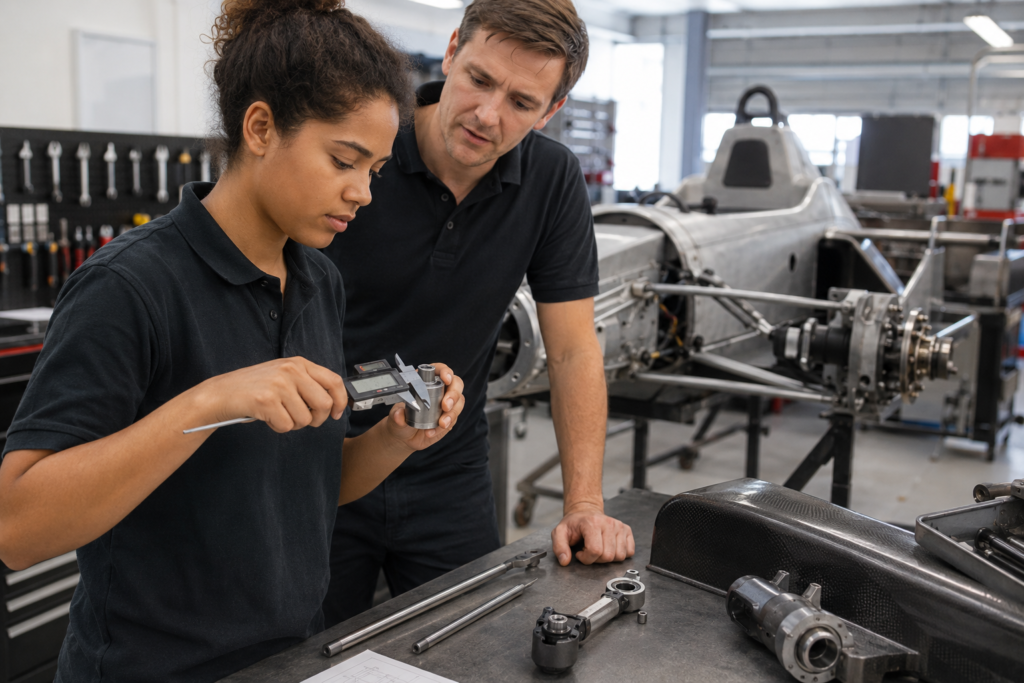
An F1 mechanic helps prepare, build, service and operate a Formula 1 car. The exact responsibilities vary by team, seniority and whether the role is based mainly at the factory or travels to races.
Typical duties can include:
- assembling and stripping car systems;
- fitting new or serviced components;
- carrying out setup changes requested by engineers;
- inspecting parts for damage or wear;
- checking that fasteners, clearances and settings meet specification;
- troubleshooting mechanical problems;
- recording completed work accurately;
- preparing equipment, spares and garage systems;
- practising and performing a designated pit-stop role; and
- keeping the car safe, legal and ready to leave the garage on schedule.
At the circuit, mechanics work closely with engineers, technicians and operations staff. Instructions have to be understood and completed quickly, but speed never excuses poor workmanship. A small mistake can cost a session, damage an expensive component or create a safety risk.
The most senior car mechanic is often called the number one mechanic. This person has overall mechanical responsibility for one car and coordinates the people working on it. A number two mechanic and other specialists support them. Titles and responsibilities are not identical at every team.
Is an F1 mechanic the same as a pit-crew member?
Not exactly. Many members of an F1 pit crew are mechanics or technicians, but a pit-stop position is usually an additional race-weekend duty rather than a separate full-time career.
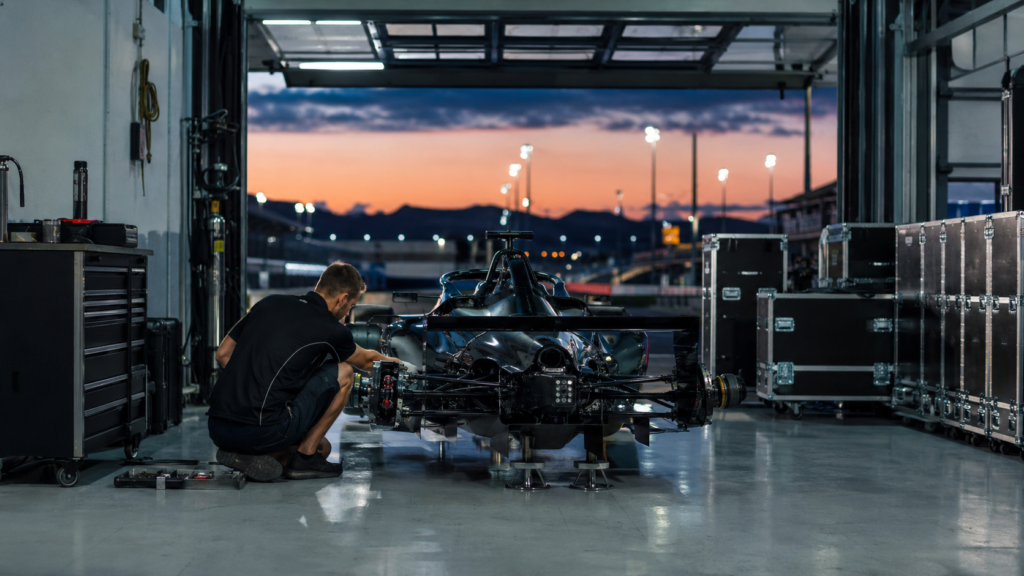
Changing a wheel during a Grand Prix is the visible part of the job. Most of the work happens away from the television cameras: building the car, checking systems, making setup changes, repairing damage, preparing spares and documenting every task.
If your only goal is to perform pit stops, you are overlooking the technical career that normally gets someone into the pit crew in the first place.
What qualifications do you need to become an F1 mechanic?
There is no single compulsory qualification accepted by every Formula 1 team. Job requirements differ, and practical experience can be as important as formal education.
Common routes include:
- an apprenticeship in automotive, motorsport, manufacturing or mechanical engineering;
- a Level 2 or Level 3 vocational qualification in vehicle maintenance, motorsport or engineering;
- a BTEC or equivalent technical qualification;
- an HNC, HND or foundation degree in motorsport engineering or automotive technology; or
- a related university degree combined with substantial hands-on experience.
Williams, for example, describes Level 3, HND and foundation-degree routes in its mechanic career guidance, while its apprenticeship programme combines a recognised qualification with paid practical experience. Entry criteria vary from programme to programme, so always check the current vacancy rather than relying on a general list.
Do you need a university degree?
Usually, no. A degree can be useful, but it is more commonly expected for engineering roles than for mechanic roles.
If you learn best through practical work, an apprenticeship or vocational motorsport course may be the better route. It can help you develop workshop discipline and recognised skills without taking on the cost of a full university degree.
University can still be valuable if the course offers extensive workshop time, placements, Formula Student or strong links with race teams. A theoretical qualification alone will not demonstrate that you can prepare a car safely under pressure.
Which school subjects are useful?
Prioritise:
- maths;
- physics or general science;
- design and technology;
- engineering; and
- computing or electronics where available.
English and communication skills matter too. Mechanics must understand job sheets, record work clearly, communicate problems and follow detailed procedures.
If you are choosing courses now, compare their workshop facilities, time spent working on real vehicles, competition programmes, work placements and graduate destinations. A course with “motorsport” in its name is not automatically better than a strong general engineering apprenticeship.
The three main routes into the profession
1. Apprenticeship route
An apprenticeship lets you earn while developing practical skills and working toward a recognised qualification. It is often the most direct option for school leavers who know they prefer workshop-based work.
You can apply to F1 teams, motorsport suppliers, high-performance engineering businesses and automotive employers. Do not restrict yourself to vacancies with “Formula 1” in the title. Skills in assembly, machining, fabrication, composites, inspection and vehicle maintenance can all support a later move into motorsport.
F1 apprenticeships attract large numbers of applicants. Apply widely and treat an apprenticeship elsewhere in professional engineering as a useful first step, not a failure.
2. College or vocational route
A good automotive or motorsport course can teach vehicle systems, workshop safety, fabrication, setup and fault diagnosis. The best courses also give students access to live race cars or placements with teams.
Before enrolling, ask:
- How many hours will I spend in a workshop?
- Will I work on running cars or mainly classroom exercises?
- Does the course support a racing team?
- Which employers offer placements?
- Where have recent graduates found work?
- Which tools, processes and qualifications will I master?
The answers matter more than the course brochure.
3. University route
A motorsport, automotive or mechanical engineering degree can broaden your options, especially if you may later want to move toward engineering, design or management.
To make this route relevant to mechanic roles, add practical experience. Join Formula Student, volunteer with a race team, work on a kart or project car and pursue placements. Your aim is to graduate with evidence of what you can build and operate, not just a certificate.
How to get motorsport experience when you have none
This is the point where many people get stuck. Entry-level motorsport jobs ask for experience, but you need an opportunity before you can acquire it.
The solution is to start below the level at which everyone is competing for the same glamorous roles.
Start locally
Look for:
- kart teams and kart circuits;
- club-racing teams;
- local rally and hill-climb competitors;
- Formula Ford and other national single-seater teams;
- touring-car and GT teams;
- track-day operators;
- race-car preparation workshops; and
- university or community motorsport projects.
Contact teams with a short, specific message. Explain what you can already do, when you are available and how you can help. “I will do anything” sounds enthusiastic but gives a team little reason to trust you. “I am studying Level 3 vehicle maintenance, have my own basic tools and can help with workshop preparation on Fridays and race weekends” is more useful.
Some early opportunities may be voluntary or expenses-only. Protect yourself from open-ended unpaid work: agree on the hours, duties, supervision and what experience you will gain. A genuine learning opportunity should steadily increase your skills and responsibility.
Make road-car experience count
Working in a commercial garage is not the same as operating a racing car, but it can build valuable foundations:
- correct tool use;
- fault diagnosis;
- clean and repeatable work;
- time management;
- safety awareness;
- inspection habits; and
- accountability for completed tasks.
You will still need to learn motorsport-specific practices, including rapid setup changes, detailed lifing and traceability, working from technical instructions and operating to a race-weekend schedule.
Build your own evidence
If paid opportunities are scarce, create a small portfolio around practical projects. You might document:
- rebuilding a kart or vehicle subsystem;
- fabricating a bracket or tool;
- measuring and correcting suspension geometry;
- creating a setup sheet and change log;
- wiring and testing a simple loom;
- carrying out a structured fault diagnosis; or
- preparing a car for a track event.
Use photographs, brief explanations and measurable outcomes. Never publish confidential team information or work you do not have permission to share.
Skills F1 teams look for
Technical ability gets you considered. Your working habits determine whether a team can trust you.
Mechanical accuracy
You must be able to follow drawings, specifications and procedures without improvising carelessly. Good mechanics check their work, maintain clean tools and notice when something does not look or feel right.
Troubleshooting
Replacing parts is not enough. You need to observe symptoms, identify plausible causes and communicate what you find. Under pressure, a calm and methodical approach is faster than guessing.
Communication
An F1 garage is a coordinated operation. Mechanics need to listen, confirm instructions, report problems early and hand work over clearly. Hiding a mistake is far more damaging than admitting it promptly.
Teamwork and humility
Nobody prepares an F1 car alone. Teams value people who support colleagues, accept feedback and care about the collective result. The job includes routine preparation and cleaning as well as high-profile technical work.
Speed under pressure
The target is controlled speed, not rushed work. You build it by repeating tasks correctly, organising tools and developing consistent processes.
Fitness and resilience
Trackside work can mean long days, awkward working positions, heavy equipment, disrupted sleep and frequent travel. Pit-stop duties also require explosive movement and repeated physical training. Fitness helps, but resilience, recovery and concentration are just as important.
Adaptability
Race plans change, parts arrive late and cars return damaged. Teams need people who can adjust without losing accuracy or becoming difficult to work with.
A realistic career ladder
A direct move from school or a road-car garage into a travelling F1 mechanic role is unusual. A more realistic progression might look like this:
School, college or apprenticeship
Build core engineering knowledge, workshop habits and practical evidence.
Karting, club racing or a preparation workshop
Learn race-weekend routines, setup work, inspections and fast turnaround.
National or junior professional championship
Take responsibility for systems or a car while working to stricter procedures and deadlines.
International junior formula, GT, endurance or another high-level series
Develop experience with professional operations, extensive travel and more complex cars.
F1 factory or support role
Learn the team’s systems, standards and components. Factory-based work can be a route toward race-team opportunities, although progression is never automatic.
Travelling Formula 1 mechanic
Prepare and operate a car at Grands Prix, usually alongside a designated pit-stop role.
Number one, chief mechanic or operations leadership
Take on responsibility for a car, a group of mechanics or broader race-team operations.
This is not the only sequence. Aston Martin’s interviews with mechanics show that careers can pass through apprenticeships, lower formulae, sportscars and other F1 teams. The repeated theme is practical experience and increasing responsibility.
Factory-based versus trackside F1 jobs
Do not assume every F1 mechanic travels to every race. Teams need large factory operations to build, service, inspect and prepare cars and components.
Factory-based roles
These may involve assembly, hydraulics, gearbox work, fabrication, composites, inspection, test and validation, heritage cars or race support. Factory roles can offer high-level technical work with less travel, although deadlines can still create demanding hours.
Trackside roles
Travelling mechanics operate the cars at tests and Grands Prix. The job may look glamorous from outside, but it involves substantial time away from home and long, physically and mentally demanding days.
Aston Martin’s 2026 documentary about its mechanics described a 24-race season involving roughly 126,000 miles of travel and 180 days away from home. That is one team’s illustration rather than a universal employment schedule, but it shows the scale of the commitment.
Apply for the work you actually want. If you enjoy precision assembly but dislike constant travel, a factory role may suit you better than the race team.
How long does it take to become an F1 mechanic?
There is no fixed timetable. Someone who begins with a two- or three-year apprenticeship may then spend several seasons building race-team experience before becoming competitive for an F1 vacancy. For many candidates, the full journey takes five to ten years. Some move faster and others take longer.
Focus on progress rather than a deadline. Each year, ask whether you are:
- working on more complex machinery;
- gaining more responsibility;
- learning from stronger colleagues;
- operating in more competitive championships;
- improving the quality of your evidence; and
- building relationships with people who trust your work.
If those things are happening, you are moving in the right direction.
How much do F1 mechanics earn?
There is no reliable public salary scale covering all Formula 1 mechanics. Pay varies by team, country, seniority, specialism, travel obligations, allowances and bonuses. Online salary figures often combine different roles or repeat estimates without explaining their source.
When comparing vacancies, look at the complete package:
- base salary;
- overtime arrangements;
- travel and race allowances;
- bonuses;
- pension and insurance;
- meals and accommodation while travelling;
- working hours; and
- time away from home.
Junior motorsport is not always highly paid, while experienced F1 personnel can earn significantly more. Choose early roles for the quality of training and experience as well as the salary, but make sure the arrangement is financially sustainable.
Where to find F1 mechanic jobs and apprenticeships
Use several sources rather than waiting for one dream vacancy:
- the careers page of every Formula 1 team;
- specialist motorsport job boards;
- race-team and engineering-company websites;
- LinkedIn and professional motorsport networks;
- college and university placement teams;
- suppliers located around major motorsport clusters; and
- direct, professional contact with teams in lower series.
Search beyond “F1 mechanic.” Relevant titles can include:
- race mechanic;
- car mechanic;
- number two mechanic;
- assembly technician;
- garage technician;
- gearbox technician;
- hydraulics technician;
- build technician;
- test technician; and
- heritage or show-car technician.
Read the description carefully. The same title can cover different responsibilities at different organisations.
How to write a strong motorsport CV
Keep your CV clear, specific and evidence-led.
Lead with relevant experience
For each role or project, explain:
- which car, championship or system you worked on;
- what you were personally responsible for;
- which tools and processes you used;
- how frequently you worked or raced; and
- what improved because of your contribution.
Instead of writing “helped prepare a race car,” write something like: “Supported pre-event inspection and setup of a Formula Ford car across eight race weekends, including fluid checks, brake changes, corner-weight preparation and post-session fault reporting.” Only claim tasks you genuinely performed.
Show reliability
Motorsport employers want evidence that you can meet deadlines, travel when required, work safely and take responsibility. Include relevant weekend availability, licences, languages and travel eligibility where appropriate.
Tailor every application
Mirror the employer’s terminology where it truthfully matches your experience. If a role emphasises assembly records, fault diagnosis or composite repair, make the most relevant evidence easy to find.
Check every detail
A CV for a precision-based role should not contain careless errors. Keep the format simple, proofread it and export it as a readable PDF unless the employer requests another format.
How to prepare for an F1 mechanic interview or trade test
An interview may test both your technical knowledge and the way you behave under pressure. You could be asked to discuss a fault you diagnosed, demonstrate a practical task or explain how you responded to a mistake.
Prepare examples showing:
- a technical problem you solved methodically;
- a time you worked to a hard deadline;
- how you handled conflicting priorities;
- a mistake you reported and corrected;
- how you improved a process; and
- how you supported a teammate.
For practical assessments, follow the brief, organise your work area and ask sensible questions where necessary. Do not sacrifice accuracy to appear fast. Employers can train someone in a team-specific process; poor judgement and dishonesty are harder to fix.
Research the role, not just the team’s racing history. Know whether it is factory-based or travelling, which systems it covers and why your experience fits.
Common mistakes to avoid
Applying only to Formula 1 teams
Your first useful opportunity is more likely to be in karting, club racing, a junior series or a specialist engineering company. A narrow search can keep you waiting while other candidates accumulate experience.
Confusing enthusiasm with evidence
Almost every applicant loves Formula 1. Employers need proof that you can contribute. Build things, work on cars, document projects and earn references.
Chasing job titles instead of skills
A strong assembly or race-preparation role outside F1 may teach you more than a loosely related position carrying an F1 brand name.
Ignoring the lifestyle
Travel, weekend work and long hours affect relationships, health and family life. Speak to people in the industry and decide whether the reality suits you.
Sending generic applications
A generic CV tells the employer you want any F1 job. A tailored application shows why you can do this particular job.
Exaggerating your experience
Motorsport is technically demanding and closely connected. Claims are easy to test. Be precise about what you did and show that you are ready to learn the rest.
A practical 12-month action plan
If you are starting today, use the next year to become visibly more employable.
Months 1–3: choose your route
- Review 20 current mechanic, technician and apprenticeship descriptions.
- Record the qualifications, skills and experience that appear repeatedly.
- Choose an apprenticeship, college or experience-building route.
- Create a one-page CV and a simple project portfolio.
Months 4–6: get hands-on
- Contact local karting, club-racing and preparation teams.
- Complete a practical project you can document.
- Improve one weak area such as electrical diagnosis, fabrication or vehicle setup.
- Ask an experienced mechanic to critique your working habits.
Months 7–9: work in a competitive environment
- Support testing or race weekends where possible.
- Keep a private log of tasks, problems and lessons.
- Request a reference once you have earned it.
- Build professional relationships without constantly asking for a job.
Months 10–12: apply strategically
- Identify roles one step above your current level.
- Tailor your CV to each vacancy.
- Practise technical and behavioural interview questions.
- Continue gaining experience while applications are open.
At the end of the year, you may not yet be ready for F1, but you should have stronger skills, better evidence and a clearer next step.
Frequently asked questions
Can I become an F1 mechanic with no experience?
You can start the journey with no experience, but you are unlikely to secure an F1 mechanic role without first proving your ability elsewhere. Begin with training, practical projects, road-car work, karting or a local race team, then progress toward professional motorsport.
Can I become an F1 mechanic without a degree?
Yes. A university degree is not normally essential for mechanic roles. Apprenticeships and vocational qualifications can provide a more direct practical route. Always check the requirements of each vacancy.
Can I become an F1 mechanic through an apprenticeship?
Yes. F1 teams and related engineering businesses offer apprenticeships in areas including assembly, manufacturing, fabrication and composites. Places are competitive, so apply to a range of high-quality employers and build practical evidence alongside your application.
Is there an age limit for becoming an F1 mechanic?
There is no general upper age limit for working as an F1 mechanic. Employers focus on skills, experience, fitness for the role and the legal requirements for employment and travel. Apprenticeship funding or entry rules may vary by country and programme.
Do F1 mechanics travel to every race?
Some travel as part of the race team, while many mechanics and technicians are primarily factory-based. Travelling schedules also depend on the role and team. Read each vacancy carefully rather than assuming all F1 jobs involve attending Grands Prix.
Are F1 mechanics also engineers?
Mechanics and engineers work closely together but perform different functions. Engineers typically analyse, design or specify changes; mechanics physically build, service and adjust the car. Responsibilities can overlap, and job titles vary between teams.
What is the best first job for a future F1 mechanic?
The best first job is one that gives you supervised, hands-on responsibility and teaches professional standards. That could be an apprenticeship, a race-preparation workshop, karting, club racing, a junior single-seater team or a high-quality automotive role.
Final advice
Formula 1 is the summit of a much larger motorsport industry. The most effective way to reach it is to stop asking how to jump straight into F1 and start asking how to become an excellent race mechanic.
Learn the fundamentals. Work on real machinery. Become the person a team can trust when time is short and the car has to be right. Progress into more demanding environments, keep evidence of what you have achieved and apply when your experience matches the job.
There are no guarantees, but there is a route: qualification, practice, lower-level motorsport, professional responsibility and persistent, well-targeted applications.
Further Reading: